


Flexo Printing Ink Rolls – Anilox Rolls
1. Introduction
In a flexo press, the ink roll is the anilox roll – a roll whose surface is engraved with millions of tiny cells that meter and transfer an even ink film to the printing plate. A press can run good ink and good plates, yet if the anilox has the wrong specification, or is worn or plugged, the print will be weak, off-color, show dirty dots or streaks.
This article explains the structure of the anilox roll, the meaning of its key specifications (line screen, cell volume, cell angle…), how to select an anilox for the print job, and what matters in use and maintenance.
2. What Is an Anilox Roll
An anilox roll is a steel roll (or aluminium/composite sleeve) coated with chromium oxide ceramic (Cr₂O₃) by plasma spraying, then laser-engraved to create uniform ink cells over the entire surface. Older designs are mechanically engraved, chrome-plated steel rolls, now used mainly for some adhesive and varnish applications.
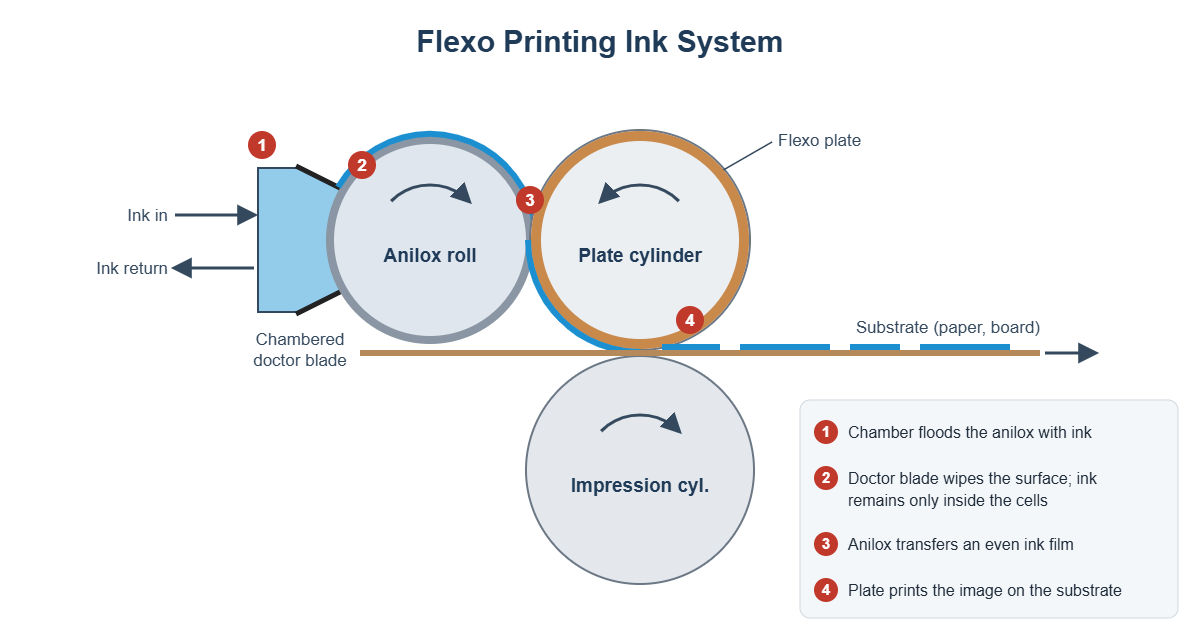
Working principle: ink floods the roll surface, the doctor blade wipes the ink off the cell walls, and only the ink inside the cells remains. Because the cell volume is fixed, the amount of ink transferred to the plate is precisely controlled and repeatable revolution after revolution.
3. Role in the Flexo Press
- Color density and uniformity: the amount of ink on the plate depends directly on the anilox cell volume, not on manual adjustment by the operator.
- Sharpness of halftones and fine text: the anilox line screen must match the plate screen; too coarse gives dirty, enlarged dots, too fine gives weak solids.
- Consistency between shifts and repeat orders: with standardized anilox specifications, color can be reproduced on every re-run.
Common ink metering systems on flexo presses:
| System | Characteristics |
|---|---|
| Two-roll (rubber roll + anilox) | A rubber fountain roll runs in the ink pan and nips against the anilox to remove excess ink. Simple, but ink volume changes with speed and nip pressure; still found on older box printers. |
| Single doctor blade | A steel or plastic blade in reverse angle wipes the roll surface. More accurate metering than the two-roll system. |
| Chambered doctor blade | Standard on today’s presses. Ink circulates in a closed chamber; ink film is stable with speed, with less evaporation, less ink spray and faster color changes. |
4. Basic Anilox Specifications
| Parameter | Meaning | Typical values / notes |
|---|---|---|
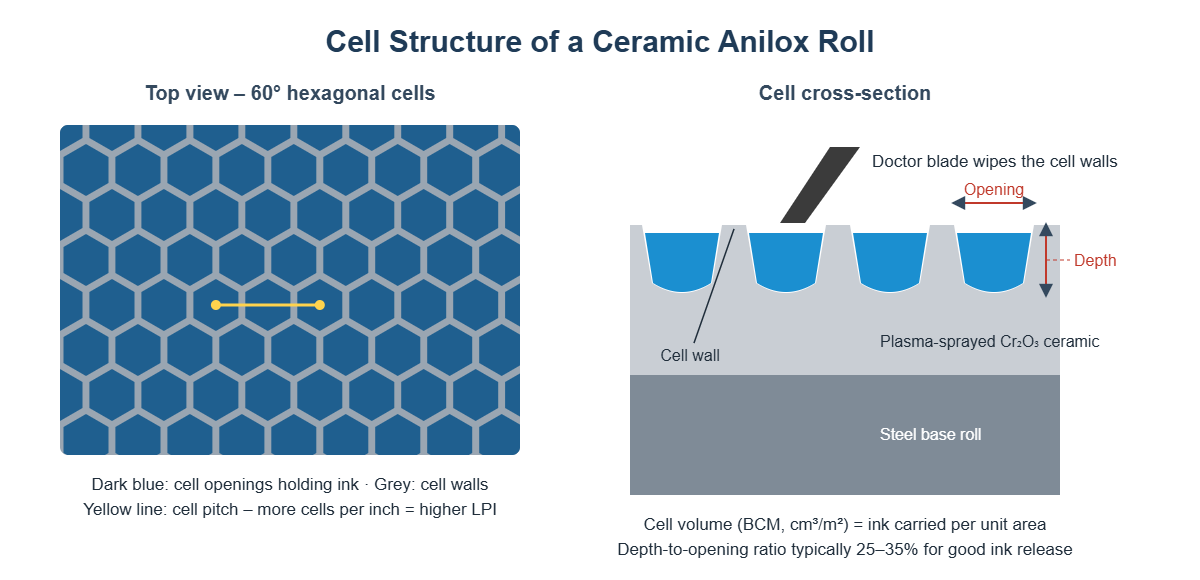
| Line screen | Number of cells per unit length along the engraving angle. Higher line screen means smaller cells and a thinner, finer ink film. | LPI (lines/inch) or L/cm. 1 L/cm = 2.54 LPI. Common range 80 – 1,500 LPI. |
| Cell volume | Ink carried per unit area – the parameter that determines color density. | BCM (billion cubic microns/in²) or cm³/m². 1 BCM ≈ 1.55 cm³/m². |
| Cell angle | Orientation of the cell pattern relative to the roll axis. | 60° hexagonal is the most common (dense packing, even transfer); 30°, 45° and elongated channel cells are used for solids and varnish. |
| Depth-to-opening ratio | Cells that are too deep hold ink at the bottom and plug easily; cells that are too shallow lack volume. | Typically about 25 – 35%. |
| Wall width | The walls support the doctor blade and the plate dots. | Walls too thin chip easily; walls too thick reduce volume and may cause streaks. |
| Surface coating | Determines wear resistance and roll life. | Cr₂O₃ ceramic with high hardness (about 1,200 – 1,300 HV), far more durable than chrome plating. |
| Runout and dynamic balance | Affect uniform contact pressure between anilox and plate, especially at high speed. | Check against the press manufacturer’s standard for new or refurbished rolls. |
Most important: line screen and cell volume always go together. Two 400 LPI rolls with different volumes will print different densities. When ordering or comparing quotations, always specify both.
5. Selecting an Anilox for the Job
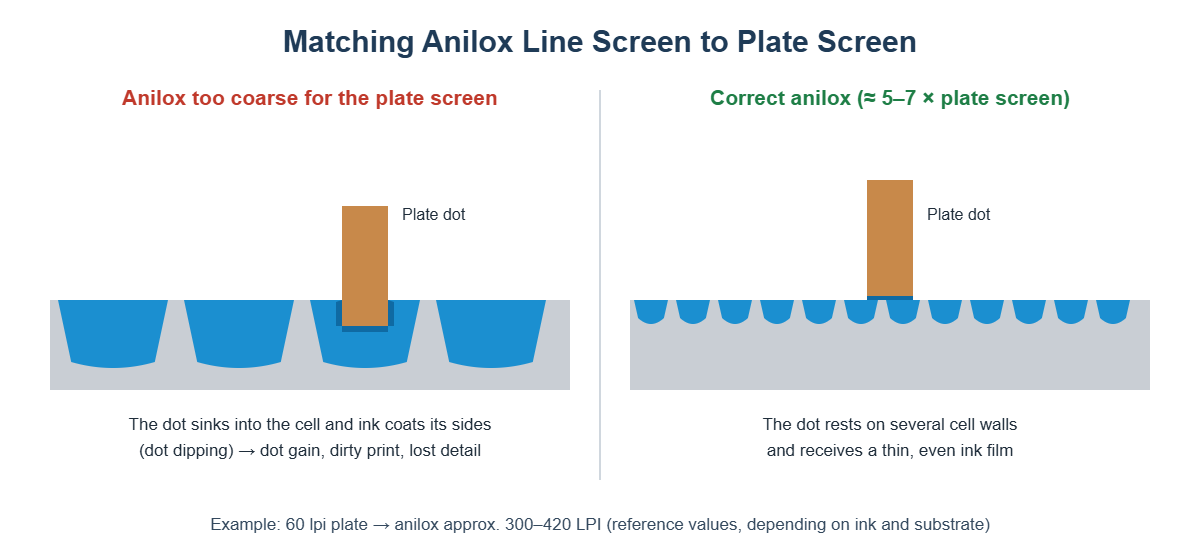
Basic rule: the anilox line screen should be about 5 – 7 times the plate screen, so that each plate dot always rests on several cell walls. If the anilox is too coarse, small dots sink into the cells and ink coats the dot shoulders (dot dipping), causing dot gain and dirty print.
Reference table for flexo printing on paper packaging and corrugated boxes:
| Application | Line screen (LPI) | Volume (BCM) | Volume (cm³/m²) |
|---|---|---|---|
| Corrugated post-print: solids, text, line work on kraft | 150 – 250 | 7 – 12 | 11 – 19 |
| Text and line work with coarse halftones (up to about 40 lpi) | 250 – 360 | 4.5 – 7 | 7 – 11 |
| 40 – 65 lpi halftones on white top liner | 360 – 500 | 3 – 4.5 | 4.6 – 7 |
| Sheet or preprint work with 100 – 150 lpi screens | 700 – 1,000 | 1.5 – 2.5 | 2.3 – 3.9 |
| Varnish, coating | 100 – 200 | 10 – 20 | 15 – 31 |
Reference values. Actual specifications should be adjusted to ink type, viscosity, substrate, press speed and each customer’s color requirements.
Other factors when ordering an anilox:
- Substrate: absorbent kraft and recycled liners need higher volume than white top or coated liners.
- Ink: water-based ink, viscosity and pigment fineness affect how well ink releases from the cells.
- Metering system: doctor blade, chamber or rubber roll – each gives a different transfer with the same anilox.
- Roll dimensions: diameter, face length, journals, bearings, keyways and mounting according to the press drawing.
- Standardized anilox set: plants with several presses should standardize anilox specifications to simplify color management and roll interchange.
6. Use, Maintenance and Common Problems
| Problem | Typical causes | Effect on print |
|---|---|---|
| Plugged cells | Dried ink in the cells due to late or improper cleaning | Gradually weaker, uneven color; operators raise viscosity or reduce speed to compensate |
| Wear, volume loss | Long-term friction with the doctor blade, excessive blade pressure | Weak color, hard to reach target shade with correct ink |
| Circumferential scoring | Contaminants in the ink; chipped, worn or incorrectly mounted blade | Dark streaks in the print direction |
| Chipped ceramic | Impact during handling or transport; foreign objects in the blade gap | Defect repeating with the roll circumference |
| Corrosion under the ceramic | Unsuitable cleaning chemicals, liquid penetrating the coating | Blistering and ceramic flaking |
- Clean immediately after each run and never let ink dry in the cells. Use chemicals suitable for ceramic; deep-cleaning methods include ultrasonic, soda blasting and laser cleaning, chosen according to roll condition.
- Control the doctor blade: correct blade type, correct angle and the lightest pressure that wipes clean; replace worn or chipped blades.
- Measure cell volume regularly and keep a record for each roll to know when to deep-clean, refurbish or replace.
- Store and transport rolls on racks with protective covers, avoiding any contact with the surface.
7. Technology Trends
- High-resolution laser engraving: uniform cells with thinner walls, allowing high volume at high line screens – dense solids with clean halftones.
- Open channel cells: cells linked into channels release ink more easily, suitable for solids and water-based inks.
- Standardized anilox sets: a fixed set of specifications across print units reduces roll changes and simplifies color control.
- Laser cleaning and 3D volume scanning: roll condition is monitored regularly instead of waiting for print defects.
8. PTS Solutions
PTS supplies Auclean Laser Life (Australia) ceramic anilox rolls, 80 – 1,500 LPI, 60° hexagonal cells, for flexo presses from Martin (Bobst Group), Isowa, Mitsubishi, Langston, Ishikawa, Sunrise, TCY, TCM, Lian Tiee, Chyan Jye, Ming Wei, Topack, Shen Maiu, Dongfang, Dinglong, Tai Yi and many other manufacturers.
- Products: Printing ink roll, Anilox screen roll.
- Advice on line screen and cell volume based on the plant’s actual print samples, inks and substrates.
- Related parts: doctor blades, ink pumps. See also flexo printing machines.
9. Conclusion
The anilox roll determines ink volume and print quality on a flexo press. Choosing the right combination of line screen and cell volume for the job, together with regular cleaning and volume checks, keeps color stable, reduces ink consumption and shortens make-ready.
Need advice on anilox rolls for your press? Send PTS the following information:
- Press brand, model and drawing or dimensions of the current roll
- Current anilox specifications (LPI, BCM) if available
- Print job: solids, text, halftones (plate screen ruling)
- Ink type and substrate