


Carton bundling machines (PE tying machines) – automatic or manual-feed bundling?
1. Introduction
Bundling is the last operation in a corrugated box plant: after printing, stitching or gluing, boxes or sheets are collected into bundles of a set quantity, tied with PE twine, then palletised, stored and shipped. This step adds no value to the product, but if bundling cannot keep up, goods pile up behind the stitchers and gluers and pull down the output of the whole plant.
Packaging plants currently use two main methods: manual-feed bundling (the worker places the bundle in the machine, which wraps and knots automatically) and automatic bundling (the machine is installed in line and receives bundles directly from a conveyor). This article compares the two and helps identify the option that fits your production scale.
2. What is a bundling machine
A bundling machine (tying machine) wraps PE twine around a bundle of boxes or corrugated sheets, tensions it, ties the knot and cuts the twine. A tied bundle holds the correct quantity, does not shift during handling and is easy to count on delivery.
The tying cycle of both machine types is: bundle moved into position → twine fed and wrapped around the bundle → twine tensioned → knot tied → twine cut → bundle discharged. The difference lies in how the bundle is fed in and out and in the auxiliary functions:
- Manual-feed bundling machine: the worker places the bundle in the machine and removes it; the machine wraps, tensions, knots and cuts.
- Automatic bundling machine: the bundle is brought in by conveyor; the machine positions it, ties it and pushes it out onto the outfeed conveyor. PLC control, with bundle settings entered on the screen.
Besides PE twine tying, plants also use strapping machines (PP strap) for boxes or packs that need to be strapped individually before shipment.
3. Role in the production line
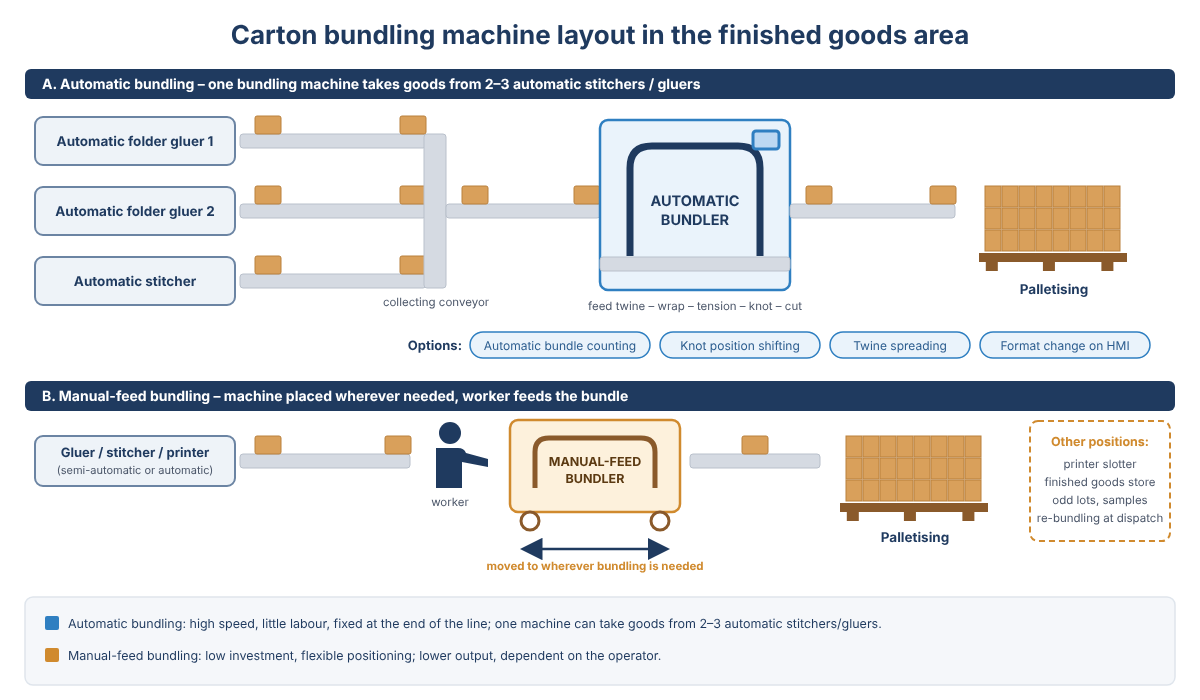
Bundling machines sit after the machines that produce finished goods: folder gluers, stitchers, printer slotters and die cutters. Bundling capacity must keep up with the combined output of the upstream machines. When stitchers and gluers are upgraded to automatic but bundling is still done by hand, the end of the line usually becomes the bottleneck: goods waiting to be bundled accumulate, more people are needed and bundle counts are easily wrong.
4. Types of bundling machine
4.1. Manual-feed bundling machine
- Compact, and can be moved to any point where bundling is needed: next to a stitcher, gluer or printer, or in the finished goods warehouse.
- The worker feeds and removes each bundle, so output depends on the operator and is lower than an automatic machine.
- No auxiliary functions such as twine spreading, knot position shifting or automatic bundle counting.
- Low investment and simple installation, with no connecting conveyor required.
4.2. Automatic bundling machine
- High speed, suited to high-capacity lines running continuously.
- One automatic bundling machine can handle the output of 2–3 automatic stitchers or gluers when a collecting conveyor is installed.
- Additional functions can be integrated: twine spreading, knot position shifting, automatic bundle counting.
- PLC control with touch screen; fast change of bundle format between orders.
- Fixed in the line, and needs floor space for infeed and outfeed conveyors.
4.3. Comparison
| Criterion | Manual-feed bundling machine | Automatic bundling machine |
|---|---|---|
| Bundle infeed and outfeed | Worker places the bundle in and takes it out | Conveyor infeed; the machine pushes the bundle out |
| Output | Low, depends on the operator | High and stable; handles 2–3 automatic stitchers/gluers |
| Installation position | Flexible, can be moved to any point | Fixed at the end of the line, connected by conveyor |
| Auxiliary functions | None | Twine spreading, knot position shifting, automatic bundle counting (optional) |
| Labour | An operator is needed at the machine at all times | Mainly supervision and twine reel loading |
| Investment cost | Low | Higher, covering the machine and connecting conveyors |
| Best suited to | Small and medium volumes, stand-alone machines, samples, re-bundling in the warehouse | High-capacity lines, automatic stitchers/gluers running multiple shifts |
5. Factors to consider when selecting a bundling machine
| Factor | What to consider |
|---|---|
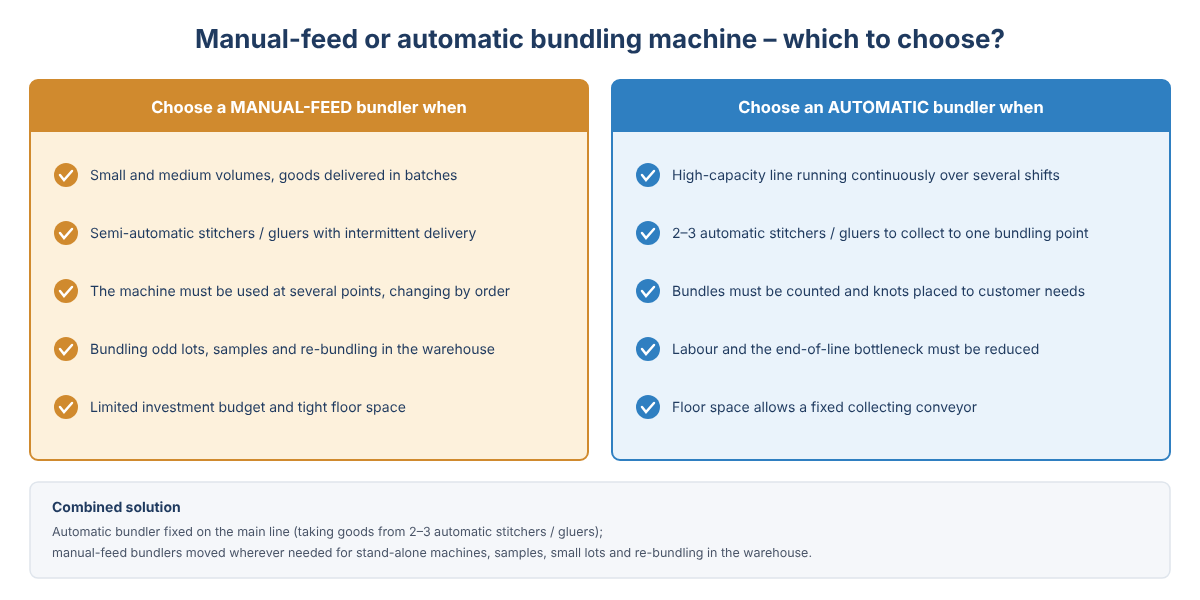
| Bundling volume | Total bundles per shift from the upstream stitchers, gluers and printers. If one bundling machine serves several machines, calculate on the combined output when they run at the same time. |
| Automation level of upstream machines | Automatic stitchers/gluers deliver continuously and suit an automatic bundling machine; for semi-automatic machines delivering in batches, a manual-feed machine is usually sufficient. |
| Bundle format | Maximum and minimum bundle width, height and length; number of twine wraps per bundle; type of goods (finished boxes or sheets). |
| Customer requirements | Knot position on the bundle, quantity per bundle, counting and recording of bundles on delivery. |
| Floor layout | Distance between the machines to be collected from, space for the collecting conveyor and palletising area; or the need to move the machine between several positions. |
| Labour | Number of people currently working on bundling, labour cost and stability of the workforce. |
| Consumables and service | Type of PE twine used and its supply; spare parts for the knotter and cutter units; on-site technical support. |
Many plants use a combined solution: an automatic bundling machine for the main line and one or more manual-feed machines for stand-alone machines, samples, small orders and re-bundling in the warehouse.
6. Technology trends
- Collecting from several machines to one bundling point: a collecting conveyor links 2–3 automatic stitchers/gluers to one bundling machine, reducing labour at the end of the line.
- Connection to the counter-ejector of the gluer: bundles leave the gluer already at the correct count and are received and tied immediately.
- Automatic bundle counting: output is recorded by order, supporting reconciliation on delivery.
- Adjustment of knot position and number of wraps to each customer requirement directly on the control screen.
- Link to automatic palletising to complete end-of-line automation.
7. Solutions from PTS
PTS supplies both types of bundling machine and advises on layout based on the actual floor plan of the plant:
- JINSHUN automatic bundling machine – for high-capacity lines, with auxiliary functions integrated on request.
- CHANG YONG manual-feed bundling machine – compact, easy to move, low investment.
- Automatic strapping machine – straps boxes and packs with PP strap.
Accompanying services: survey of output and floor space, proposal of a collecting conveyor layout, installation, trial run, operator training and spare parts supply. See also: stitching machines.
8. Conclusion
A manual-feed bundling machine suits plants that need flexible positioning, have small to medium volumes and a limited budget. An automatic bundling machine suits high-capacity lines, where one machine can replace several people and take goods from 2–3 automatic stitchers or gluers. The right choice keeps the end of the line from becoming a bottleneck and keeps labour costs under control.
Need advice on choosing a bundling machine? Send PTS the following information:
- The upstream machines to be served (stitchers, gluers, printers) and their level of automation
- Output per shift and number of boxes/sheets per bundle
- Maximum and minimum bundle dimensions
- Finished goods area layout and any requirements for knot position and bundle counting